http://openttdcoop.myminicity.com/

#openttdcoop.org @ myminicity.com


Join our small town #openttdcoop, located in the heartlands of the United Kingdom 😉

Update:
Some of us should visit http://openttdcoop.myminicity.com/ind instead. It is the next level.
Update 2:
Level three is now unlocked, please use: http://openttdcoop.myminicity.com/tra to improve our transport network.
Update 3:
I installed a little plugin which automatically generates the best link to trigger and also shows you our stats (thx Doke for the XML link).

OpenTTD 0.6.0-beta4

Grab it while it’s hot. Tonight the developers released the forth beta of OpenTTD 0.6.0. The list of features and fixes is huge and shows how much effort the developers put into this project. Great.

You can find the binaries as well as the source code at SourceForge.

This is a little excerpt of the amazing list of changes:
Read the rest of this entry »

Even or Odd – About Tilelengths

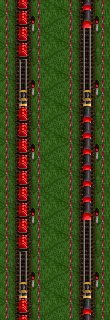
Tilelengths 5 (left) and 4 (right) on diagonal trackWhenever starting a new game, be it local or on #openttdcoop, one important question to be cleared before starting to build the network always is: “What tilelength (TL) are we going to use for our trains?”.
The chosen setting will mostly depend on the size of the map, as you don’t want to have a hundreds train servicing a single coal mine on a 2048*2048 map. However, there is a great difference between using even tilelengths such as 4, 10 or 20 and odd ones like 5 or 11.

The patch setting “When dragging, place signals every: X tiles” should always be set to “2” when playing on #openttdcoop, and most players will also use this setting if playing alone. If dragging signals, you will always have one piece of track with a signal on it followed by one without one and so on.

Now, if trains are jamming up somewhere in the network, for example behind a full station, those trains should block as little space as possible, so that they won’t for example block the mainline.

As you can see in the first screenshot, with signals every 2 tiles, the trains with tilelength 5 (left) fit almost perfectly in between the signals. However, the TL4-trains (right) always have a gap of more than one tile between them and need as much space as the TL5-trains. To fix that, you would have to place additional signals in the gaps, which might look ugly (especiall for straight track, see below) and is a lot of work, as you would have to do it manually.

Read the rest of this entry »
Some Blogstats

Good afternoon,

many people question themselves about how large our community actually is. Well, if you define the size of a community on the number of active members, one could estimate some 50-70 regular players.

Another figure for the vitality of a community is the number of visitors and viewers “in the background”. This is some proper measurement for the vitality and attractivity of an online community. Therefore, I’ll give you some facts and figures about our blog today.

These rough figures below are for February so far (therefore, some 6 days).
Visits (without bots): 2149
Visits (bots only): 1443
Unique visits(without bots): 1676
Read the rest of this entry »

SML Shiftback

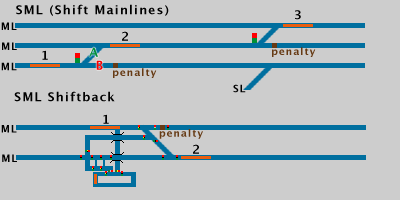
It has been a while since this idea came in my mind. I experimented to find a better way managing the train flow. The main idea of the SML concept is to shift trains to other tracks if they are free and joining trains use this free track. If the track is not free, the others aren’t either. This works very well but has a disadvantage too: train’s entering a station will primarily enter via the shift-tracks (the innermost).
SML Sketch
That’s the point where “shiftback” comes into play.
Read the rest of this entry »